
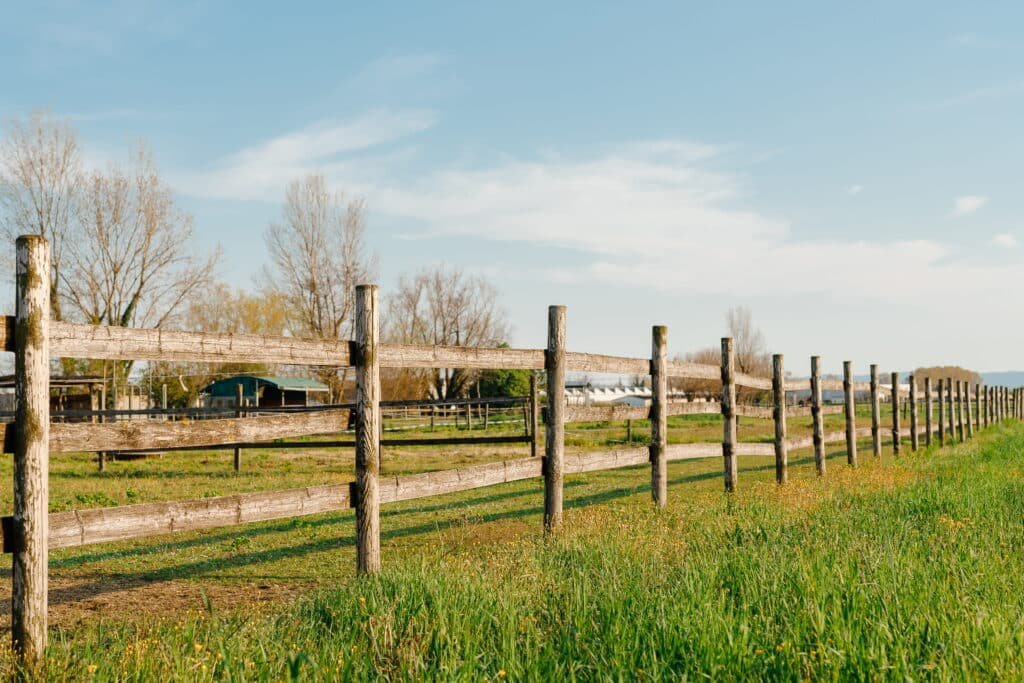
Choosing the right livestock fence is one of the most critical, and potentially costly,decisions a property owner can make. In Florida, where the climate is harsh, the vegetation is aggressive, and the predators are persistent, your fence is more than a boundary; it is a vital tool for animal safety, daily management, and long-term liability protection.
When evaluating Barbed Wire vs. Woven Wire Fencing, you aren’t just comparing prices; you are comparing two distinct philosophies of land management. At Bells Outdoor Services, we understand that every property, from sprawling North Central Florida cattle ranches to small equestrian hobby farms, has unique requirements.
This guide provides an in-depth comparison of these two fencing titans, species-specific recommendations, and the essential steps to ensure your investment lasts for decades.
Why Your Fencing Choice Matters (Beyond Containment)
Before we start comparing materials, it is essential to recognize that a high-quality fence serves multiple functions. According to agricultural best practices and the University of Florida IFAS Extension, a functional agricultural fence must:
- Contain livestock safely without causing unnecessary injury.
- Deter predators (coyotes, stray dogs, wild hogs) and trespassers.
- Withstand environmental stressors, including extreme heat, high humidity, and heavy rainfall.
- Support rotational grazing and land management strategies.
- Increase property value while meeting insurance and liability expectations.
The Risks of the Wrong Choice: Using the incorrect material or poor installation techniques often results in frequent repairs, escaped livestock, and devastating animal injuries. When weighing Barbed Wire vs. Woven Wire Fencing, the safety of your specific animals must be the deciding factor.
Deep Dive: Barbed Wire Fencing
Barbed wire has been the agricultural standard since the late 19th century. It consists of multiple steel strands (typically two) twisted together with sharp barbs at regular intervals (usually 4 to 5 inches apart).
The Pros: Efficiency and Cost
- Highly Cost-Effective:Barbed wire is significantly more affordable per linear foot. This economic advantage makes it the go-to solution for large acreages and perimeter boundary lines where thousands of feet of fencing are required.
- Speed of Installation:It requires fewer materials and slightly less labor than woven wire, allowing for faster project completion.
- Effective for Cattle:Large, thick-skinned livestock like cattle quickly learn to respect the “psychological barrier” of the barbs. Once trained, they rarely challenge the fence line.
- Durability:When properly tensioned and braced, barbed wire resists sagging and can last for decades in open pasture environments.
The Cons: Risk and Permeability
- Injury Potential:The sharp barbs can cause severe cuts, puncture wounds, and infections. This is particularly dangerous for thin-skinned animals like horses, dairy cattle (udder injuries), or young, panicked animals.
- Limited Predator Protection:Most predators, such as coyotes or wild hogs, can easily slip between or under the strands. It offers virtually no barrier against small animals entering or leaving.
- Escapability:Smaller livestock like goats or sheep can often navigate through the horizontal gaps, making it unsuitable for these species without modification.
Deep Dive: Woven Wire Fencing
Often called “field fence,” “no-climb,” “hog wire,” or “page wire,” woven wire consists of horizontal and vertical wires knotted together to create a solid mesh grid. The spacing of the grid varies, with 2”x4” (non-climb) and 4”x4” being common standards.
The Pros: Safety and Security
- Superior Animal Safety:By eliminating sharp barbs and creating a visible, solid boundary, woven wire minimizes the risk of animals getting tangled or sliced. This is the Safeguardyour horses need.
- Predator Control:The tight mesh pattern acts as a physical wall. A properly installed woven wire fence (often with a strand of barbed wire at the bottom to prevent rooting) deters smaller predators and prevents livestock from “testing” the fence.
- Versatility:This is the gold standard for mixed-species operations. If you run cattle and goats together, or horses and sheep, woven wire handles them all.
- Structural Integrity:If one wire breaks, the remaining mesh usually stays intact, maintaining the fence’s overall strength until repairs can be made.
The Cons: Upfront Investment
- Higher Costs:The materials are more expensive, and the fence requires heavier-duty posts (often larger diameter) and more intensive labor for installation.
- Complex Installation:Woven wire must be stretched to the specific tension recommended by the manufacturer to act like a spring; poor tensioning leads to sagging or failure.
- Maintenance Needs:Vegetation can grow into the mesh, which may trap moisture and lead to premature rusting if not managed properly.
The “Florida Factor”: Corrosion, Soil, and Storms
When debating Barbed Wire vs. Woven Wire Fencing, you must account for Florida’s aggressive environment. A fence that lasts 30 years in Arizona might rust away in 5 years in Florida if the wrong materials are chosen.
1. The Humidity and Salt Air
Florida’s high humidity and proximity to the coast accelerate oxidation (rust).
- The Solution: Class 3 Galvanization.
Standard “big box store” wire is often Class 1 galvanized, which has a thin coating of zinc. For Florida, Bells Outdoor Services recommends (and uses) Class 3 galvanized wire. It contains nearly three times the zinc coating of Class 1, offering a lifespan of 20+ years compared to the 5-7 years of lesser wires.
2. Sandy and Clay Soils
Florida soil ranges from sugar sand to heavy clay.
- Sand:Posts can easily shift or be pulled out if not anchored deep enough. We often use longer posts or concrete collars in sandy regions.
- Clay/Muck:Holds water, which can rot wooden posts. We recommend pressure-treated pine (CCA treated) to ground-contact standards or steel posts for longevity.
3. Vegetation Growth
Florida’s growing season is nearly year-round. Vines and brush grow rapidly.
- Impact:Vines growing on woven wire add weight and wind resistance. During a hurricane, a vine-covered woven wire fence acts like a sail and can be blown flat. Barbed wire allows wind to pass through more easily.
- Tip:Regular fence line maintenance is crucial for woven wire survival in Florida.
Species-Specific Recommendations
Your “herd” should dictate your fence choice. Here is our breakdown:
| Livestock Type | Recommended Fencing | Why? |
| Beef Cattle | Barbed Wire(5-strand) | Cost-effective for large acreages; cattle respect the barbs and have thick hides. |
| Horses | Woven Wire(2″x4″ Non-Climb) | Essential to prevent leg entanglement and “degloving” injuries. Never use barbed wire for horses. |
| Goats / Sheep | Woven Wire(4″x4″) | These are “escape artists.” They will crawl through barbed wire instantly. |
| Pigs / Hogs | Woven Wire+ Electric | Pigs root under fences. A strand of barbed or electric wire at ground level is needed. |
| Mixed Herds | Woven Wire | One system that safely contains all sizes and species is the best investment. |
Legal Fences: Understanding Florida Statute 588
As a landowner, you must adhere to the law to avoid liability if your animals escape and cause a traffic accident.
Florida Statute 588.011defines a “legal fence” generally as:
- At least 3 feet in height.
- Made of barbed or other soft wire consisting of not less than three strandsof wire.
- Posts standing not more than 20 feet apart.
While three strands are the legal minimum, Bells Outdoor Services rarely recommends fewer than four or five strands for cattle to ensure genuine containment. For Barbed Wire vs. Woven Wire Fencing, both meet the legal definition if installed to these height and post-spacing standards.
- Liability Note:Florida is a “closed range” state. This means the livestock owner is liable if their animals roam at large and cause damage. A secure woven wire fence offers a higher tier of liability protection because it is harder to breach.
Predator Control: Coyotes, Dogs, and Bobcats
In Florida, the threat isn’t just animals getting out; it’s what gets in.
- The Coyote Threat:Coyotes are present in all 67 Florida counties. They are agile and can slip through the strands of a standard barbed wire fence effortlessly.
- Domestic Dogs:Often a bigger threat than wild predators, loose dogs can harass and kill livestock.
- The Verdict:If predator control is a priority, Woven Wire is the clear winner.
- Pro Tip:For maximum security, we recommend a woven wire fence with a single strand of barbed wire or electric wire running along the top (to stop jumping) and one along the bottom (to stop digging).
The Foundation of a Great Fence: Land Clearing
The best fencing material will fail if the ground isn’t prepared correctly. You cannot install a tight, straight fence through a thicket of Palmetto and Brazilian Pepper.
Professional Forestry Mulching and Land Clearing are vital for several reasons:
- Straight Lines:A clear path ensures the fence is straight, which is critical for maintaining even tension. Curves weaken the wire structure.
- Leveling:Woven wire requires a level surface so the bottom wire stays flush with the ground, preventing animals from crawling under.
- Access:Clearing allows heavy equipment to drive posts to the necessary depth for stability against tropical storms.
At Bells Outdoor Services, we often perform forestry mulching as the “Phase 1” of our fencing projects, ensuring your fence has a clean, workable canvas.
Cost Comparison: Barbed Wire vs. Woven Wire Fencing
While prices fluctuate based on steel markets, here is a general ratio of what you can expect in the current market.
| Feature | Barbed Wire System | Woven Wire System |
| Material Cost | $ | $$$ |
| Labor Intensity | Moderate | High |
| Post Requirements | Standard spacing (12-15ft) | Closer spacing or heavier posts often required |
| Maintenance Cost | Low (re-stretching rarely needed) | Medium (weed eating, vine removal) |
| Est. Price per Foot | $3.50 – $6.50(Installed) | **$6.00 – $12.00+** (Installed) |
Note: These ranges are estimates. Terrain difficulty, brush density, and gate quantities will affect the final quote.
Professional Installation is Non-Negotiable
Poor installation, not the choice of material, is the number one reason fences fail early in Florida. Whether you choose Barbed Wire vs. Woven Wire Fencing, the physics of the fence rely on the corners.
The H-Brace:
The corners of your fence bear the entire tension load of the wire line. If the corner posts are not properly braced with a horizontal cross-member and diagonal tension wire (creating an ‘H’ shape), the corner post will lean over time.
- Barbed Wire:requires strong braces.
- Woven Wire:requires exceptionalbraces. The tension on a woven wire fence is significantly higher than barbed wire.
Bells Outdoor Servicesensures:
- Proper Corner Bracing:Built to withstand thousands of pounds of pull.
- Correct Tensioning:We use torque-specific tools to prevent the “crushing” or “snapping” of wires during temperature shifts.
- Expert Site Evaluation:Matching the fence layout to the natural contours of your land.
Conclusion and Next Steps
Investing in your property’s perimeter is an investment in peace of mind.
- Choose Barbed Wire if:You have large acreage, primarily raise beef cattle, and need a cost-effective legal boundary.
- Choose Woven Wire if:Animal safety is your #1 priority, you have diverse livestock (horses, goats), or you need maximum predator protection.
Don’t gamble with the safety of your herd or the liability of your land. Whether you need a 5-strand barbed wire perimeter or a high-tensile no-climb horse fence, expert installation is the key to longevity.
Ready to Secure Your Land?
At Bells Outdoor Services, we don’t believe in a one-size-fits-all approach. We evaluate your soil, your livestock, and your long-term goals to build a fence that stands the test of time.
Would you like me to schedule a site consultation to evaluate your property’s fencing needs?

