
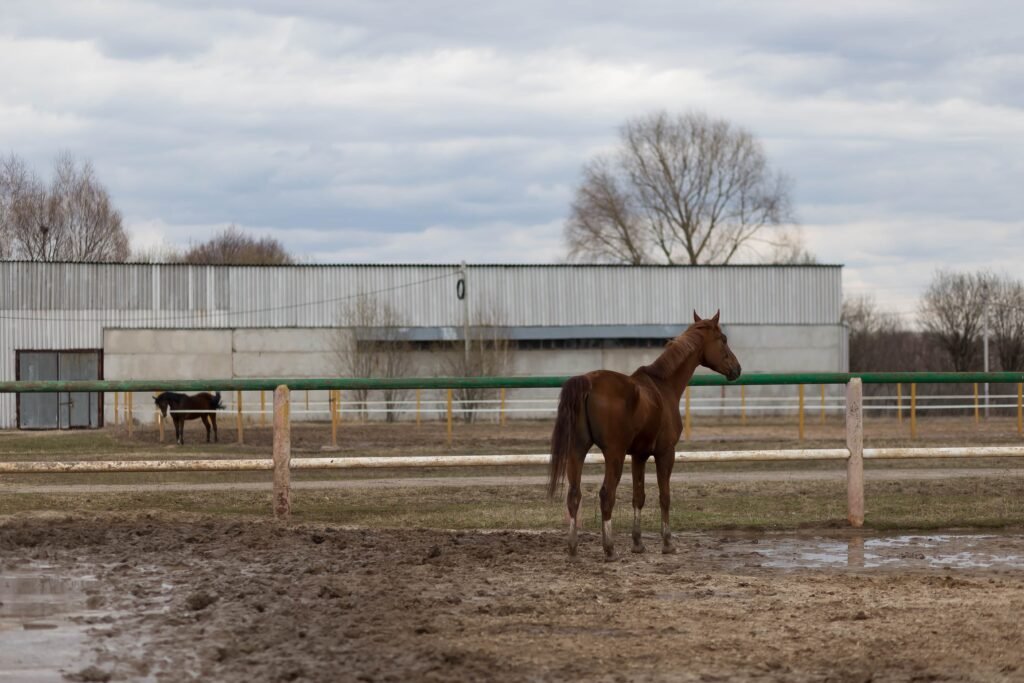
For any equestrian in Central Florida, the arena is the heart of the property. It is where hours of training happen, where bonds are forged, and where performance is honed. However, there is nothing more frustrating than looking out at your arena after a typical Florida afternoon downpour and seeing a lake instead of a riding surface.
You have invested in premium sand, you drag it religiously, and yet, you are still losing training days to “wet footing.” If this sounds familiar, you are facing a critical issue: equestrian arena drainage.
If your horse consistently avoids certain spots, struggles for traction, or slips where it shouldn’t, the problem likely isn’t your training or even the footing material itself, it is the drainage system hidden beneath. At Bell’s Outdoor Services, we specialize in turning these “footing failures” into high-performance surfaces that withstand the unique challenges of the Florida climate.
This guide provides a deep dive into the science of equestrian arena drainage, the specific challenges of the “Horse Capital of the World“, and the engineered solutions required to keep you in the saddle year-round.
The Science Behind Equestrian Arena Drainage
Most arena owners assume that if the surface is bad, they just need “better sand.” In reality, footing is only as good as what’s beneath it. You can invest in the most expensive European fiber additives or custom silica sand blends, but if the water has nowhere to go, those materials will fail prematurely.
To understand equestrian arena drainage, you must think of your arena like a house.
- The Footing:This is the carpet (the top layer of sand/fiber).
- The Base & Sub-Base:This is the concrete foundation.
If the foundation cracks, sinks, or tilts, it doesn’t matter how expensive the carpet is; the floor will be uneven. 90% of footing failure stems from the base and sub-base.
When drainage fails, the water acts as a lubricant between the particles of your base. This leads to three major structural issues:
- Inconsistent Moisture Retention:This creates “greasy” surfaces where the horse loses confidence in their step.
- Sub-Surface Erosion:Water channels carve out ruts underneath your mats or sand, creating voids you cannot see from the surface.
- Density Variance:You develop hard spots that feel like concrete sitting right next to deep pockets that act like quicksand.
This isn’t just an inconvenience; it is a structural failure that requires professional intervention.
Why Bad Drainage Causes Equine Injuries
Before we discuss dirt and pipes, we must discuss the horse. Poor equestrian arena drainage is a leading cause of soft tissue injuries in performance horses.
When a horse lands a jump or executes a sliding stop, the load on their limbs is immense. To support this, the ground must offer:
- Shear Strength:The footing must allow for a small amount of slide (to absorb impact) but then “lock up” to provide a platform for the next stride.
- The Drainage Effect:When an arena drains poorly, water pools in the sub-base. This creates “false ground.” To the rider’s eye, the sand looks flat. But when the hoof lands, it punches through the saturated base.
This sudden loss of stability causes the horse to hyperextend tendons and strain ligaments. We see this often in Ocala, horses that come up lame not because of an accident, but due to repetitive strain from compensating for inconsistent ground.
Expert Note:“A dry arena isn’t just about riding time; it’s about the longevity of your equine partner’s career. Fixing your drainage is cheaper than a single vet bill for a suspensory injury.”
For more on equine biomechanics and footing, resources like theUnited States Equestrian Federation (USEF)offer guidelines on safety standards.
5 Signs Your Equestrian Arena Drainage Has Failed
Many owners assume footing issues are just a normal part of farm maintenance. However, specific signs indicate that the engineered drainage, not your dragging schedule, is the root problem.
1. The “Teacup” Effect (Standing Water)
If puddles form in specific spots and take days to disappear, your base has developed depressions. Water sits in these “bowls,” saturating the sand and turning it into sludge. Even after the puddle dries, that spot will remain softer than the rest of the ring.
2. Uneven Compaction
If some areas feel rock-hard while others are loose and deep, water is migrating and compacting the base inconsistently. This forces the horse to constantly adjust their balance, leading to mental and physical fatigue.
3. Material Mixing (The Danger Sign)
If you see rocks, larger stones, clay, or native soil appearing in your top sand, stop riding immediately. This means your horse’s hooves have “punched through” the protective base layer. The equestrian arena drainage system has failed, and the base is actively disintegrating.
4. Footing “Slides”
If the footing moves sideways during turns or stops (often called “rolling”), it is likely sitting on a saturated base that has lost its friction. The base has become slick, and the sand is simply sliding on top of it like marbles on glass.
5. Persistent Mud
Mud isn’t just a surface issue; it’s a failure below. If the sub-base stays wet, mud will continue to reappear regardless of how much you drag the arena.
The Florida Factor: Specific Challenges in Ocala & Marion County
Equestrian properties in Ocala, Marion County, and Gainesville face challenges that northern arenas do not. At Bell’s Outdoor Services, we understand local topography and weather patterns.
High-Intensity Rainfall
Florida is known for sudden, heavy storms rather than gradual rain. An effective equestrian arena drainage system must be able to move three inches of rain in an hour, not just an inch over a day. Standard “French drains” used in drier climates often cannot handle the sheer volume of a Florida summer storm.
The Deception of Sandy Soil
While North Central Florida is blessed with sandy soil that drains well naturally, this native sand is often too fine and too round. It does not compact hard enough to form a true base. This leads to “bottomless” arenas where horses struggle for traction. Furthermore, without a stabilized base, heavy rains cause rapid erosion, washing your expensive footing into the neighbor’s paddock.
Flat Terrain and Shallow Water Tables
Much of the terrain in our region is flat, which limits natural runoff. Additionally, shallow water tables mean that once the ground is saturated, there is nowhere for additional water to go without an engineered system involving swales and retention ponds.
Our 6-Step Engineered Solution
We don’t believe in “patch jobs.” You cannot fix equestrian arena drainage by simply dumping more sand on top. We treat the arena as an integrated structural system.
Our process involves six critical steps to ensure longevity and performance:
Step 1: Site Evaluation & Laser Grading
You cannot “eyeball” a riding arena. A slope difference of just 1% determines whether water flows off or sits in the middle. We use laser-guided grading equipment to ensure precision to within fractions of an inch.
- The Crown:We often build a “high point” in the center that slopes 1-2% toward the edges.
- The Single Slope:On hillsides, we use a single-slope grade to direct water to a specific channel.
Step 2: The Engineered Sub-Base
This is the load-bearing layer. We use materials like compacted limerock or crushed concrete aggregate (a sustainable, high-performance option). We install this in “lifts” (thin layers), wetting and compacting each one with heavy vibration rollers until it is nearly as hard as asphalt. This prevents the horse from ever touching the native dirt below.
Step 3: Advanced Drainage Systems
Once the water moves off the surface, it must be diverted away from the arena perimeter so it doesn’t flood back in.
- French Drains:Perforated pipes installed in trenches lined with geotextile fabric and backfilled with washed gravel.
- Swales & Berms:Sculpted grassy channels that guide water to retention areas or ponds.
Step 4: Geotextile Separation Barriers
To prevent your base rock from migrating into your silica sand, we install a heavy-duty, non-woven geotextile membrane. This acts as a filter, allowing water to pass through into the drains while keeping the costly footing layers separate from the base.
Step 5: Discipline-Specific Footing
Finally, we install the top layer. Different disciplines require different “shear strength” and “cushion.”
- Jumpers:Need high shear strength for takeoff.
- Dressage:Require more cushion and “loft.”
- Reiners:Need a specific mix for sliding stops.
We recommend angular silica sand because the particles lock together for stability, unlike round beach sand which “rolls” under the hoof.
Step 6: Site Cleanup and Finish
We ensure the surrounding area is pristine. If your project requires extensive site prep, learn more about ourLand Clearing Servicesto see how we handle vegetation and debris removal.
Why DIY Repairs Often Fail
We often receive calls from property owners who rented a skid steer for a weekend to fix their arena, only to make the problem worse.
The “Bowl” Mistake
Amateur grading often results in removing too much dirt from the center, inadvertently creating a bowl shape. This traps water in the middle of the arena, requiring expensive remediation to bring in fill dirt and re-level the site.
The Compaction Issue
Proper base compaction requires industrial vibratory rollers, not just driving over it with a pickup truck. Without proper compaction density testing, the base will shift within months, ruining the equestrian arena drainage you tried to install.
Permitting and Zoning
In many parts of Marion County and Alachua County, significant “cut and fill” operations may require a stormwater permit, especially if the arena is near wetlands. As a professional contractor, Bell’s Outdoor Services ensures your project meets local runoff regulations (NPDES) to prevent legal headaches.
Maintenance Rules for Longevity
Even a perfectly built arena will fail without proper care. To keep your equestrian arena drainage system functioning, follow these rules:
- Vary Your Dragging Pattern:If you only drive in circles, you will eventually push all the footing to the outside rail, creating a berm that traps water on the track. Alternate your patterns (circles, figure-8s, diagonals).
- Monitor Footing Depth:Check your depth monthly. If the sand gets too thin, your drag teeth might catch and rip the expensive geotextile fabric or scar the base.
- Vegetation Management:Keep grass and weeds from growing on the arena edges. These act like a dam, trapping water on the riding surface.
- Clean Your Channels:Ensure that swales and French drain outlets are clear of debris after major storms.
- Manure Removal:Organic matter (manure) breaks down into dust and fines, which clog the pores of your footing and base, reducing drainage speed. Remove manure daily.
For more tips on maintaining agricultural land and drainage, check out theUniversity of Florida IFAS Extension.
Frequently Asked Questions
Q: Can I just add more sand to fix my wet spots?A: No. Adding sand to a drainage problem is like putting a band-aid on a broken bone. It just makes the mud deeper and the eventual repair more expensive. You must fix the base first.
Q: Is 1% slope enough to feel while riding?A: No. A 1% to 2% slope is the industry standard for outdoor arenas. It is enough to move water efficiently without being noticeable to the horse or rider’s balance.
Q: Does Bell’s help with covered arenas?A: Yes. We handle all site preparation, drainage, and high-compaction pad construction required to support the roof structure of a covered arena.
Q: How much does a drainage correction cost?A: Costs vary based on arena size and material needs. However, a correctly engineered system can extend the life of your footing by 5–10 years, offering a massive Return on Investment compared to buying new sand every two years.
Ready to Ride Rain or Shine?
Equestrian arena drainage is the difference between frustration and confidence. Arenas don’t fail overnight; they fail quietly beneath the surface until safety concerns and maintenance costs become overwhelming.
If your arena stays wet longer than the surrounding grass, or if you are tired of spending money on footing that disappears after every storm, it is time for a professional evaluation.
Let’s build a foundation that supports your goals, and your horse.
Contact Bell’s Outdoor Services today to schedule your site evaluation and soil assessment.
📞 (352) 817-6615📧 DavidBell@bellsos.com🌐 Visit:Bell’s Outdoor Services

